The NHS is committed to achieving 2% year-on-year productivity gains and to becoming “the world’s most collaborative public healthcare provider.” But how do you turn collaboration from aspiration into operational reality, and make efficiency gains stick?
This was the focus of the fourth and final event in NHS SBS’s ‘Futureproofing the NHS’ roundtable series, titled ‘The NHS of tomorrow – embedding shared services for lasting transformation.’
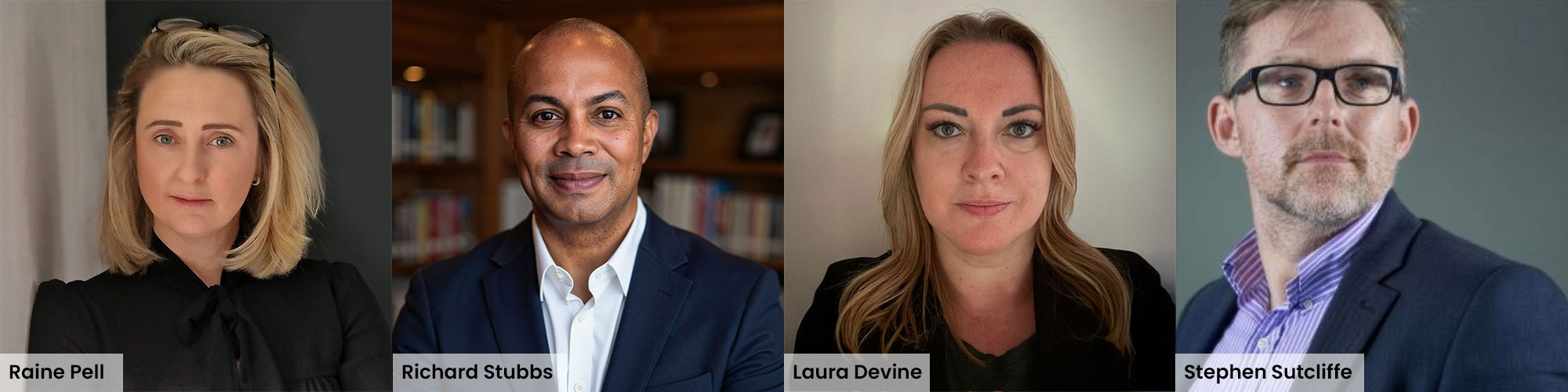
The session, chaired by Raine Pell (Executive Director of Marketing and Communications at NHS SBS), brought together Richard Stubbs from Health Innovation Yorkshire & Humber with Stephen Sutcliffe and Laura Devine from NHS SBS to explore what it takes to embed collaboration for lasting impact.
The central message that came through was that the barriers to collaboration are less about technology or structure than about culture, ownership, and the willingness to do things differently.
Five key points from the panel
- Collaboration is cultural, not structural. Richard Stubbs framed the challenge as “club versus country”, where staff are being asked to shift loyalty from their organisation to the system. He was clear that this cannot be imposed: “It’s a journey that we need to take people on, rather than doing it to people.” Stephen Sutcliffe agreed, arguing that most people want to collaborate, the question is what’s blocking them: “Sometimes we don’t help individuals. We don’t provide the safety net around them, support them when they’re challenging that, incentivise them in the right way” [edited for clarity].
- Data visibility unlocks procurement collaboration. Laura Devine argued that effective procurement depends on standardised, comparable data across the system. She pointed to NHS SBS’s work with Norfolk & Waveney, where a unified platform revealed £7.3 million in previously invisible savings and reduced requisitioning time by 90%. She added, “That’s one ICS. Imagine what we could do if we pull that together at a national level” [edited for clarity].
- Implement once, at scale. Richard Stubbs made the case for aggregation: “The implementation is just as hard in sites two, three, four, five and 99 as it is in site one. It doesn’t get easier.” Rather than implementing 450 times, the NHS should do things once and cover the whole footprint, he said. Stephen Sutcliffe offered proof that this works, pointing out that NHS SBS has saved over 500,000 person-hours through robotic process automation by investing once and delivering for all its clients.
- Fund the change, not just the tech. Laura Devine identified funding constraints as a key barrier to scaling digital pilots. These are short-term, piecemeal investments that make multi-year planning difficult. Richard Stubbs pointed to underinvestment in user experience: “Tech companies in the States put an awful lot of money into getting world-class experts to make sure systems are designed to be intuitive, plug and play. I think unfortunately for us in the NHS, we’re probably not yet investing the kind of volume of funding that’s needed” [edited for clarity].
- Governance can enable or fragment. Laura Devine warned that siloed governance structures keep priorities organisation-facing and prevent collective decision-making. What works are formalised structures with cross-organisational representation, empowered decision-makers, and shared goals agreed at the outset. “What sticks is when there’s a culture of transparency – promoting openness, honesty and communication. That will build the trust that is required” [edited for clarity].
What the panel showed us
The discussion made clear that the NHS has evidence of collaboration working, from RPA saving half a million people hours to Norfolk & Waveney revealing millions in hidden savings, but these remain exceptions rather than the norm. Progress requires leaders who are willing to prioritise the public purse over institutional interests, governance that empowers collective decision-making, and sustained investment in change management and technology.
Richard Stubbs captured the shift in mindset that is needed: “Collaboration really requires that organisational-badgeless devolved sovereignty, on the basis that you’re going to get more than you have to relinquish.”
What’s next
This was the final session in our Futureproofing the NHS series. A white paper drawing on insights from all four webinars will be published in spring 2026, so watch this space.